
Traveling Tokyo with Both a "Pack It All In" Person and a "Take It Easy" Person: How to Plan Around a Street Kart Tour
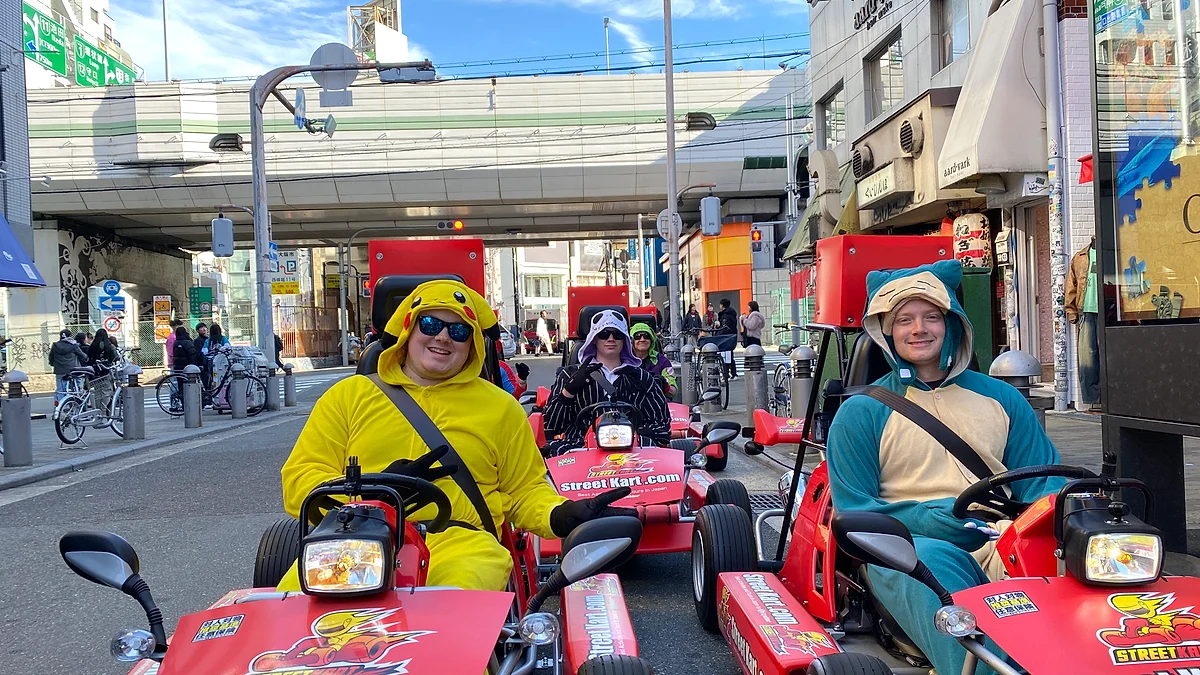
Traveling Tokyo with Both a "Pack It All In" Person and a "Take It Easy" Person: How to Plan Around a Street Kart Tour
Some people want to hit famous sights from morning to night. Others just want to sit by a café window and let their mind wander.
It's completely normal to have both on the same trip.
If you're adding a street kart tour to a Tokyo itinerary, the key isn't the tour itself. It's how you plan what comes "before" and "after" it. The people who drive and the people who don't each spend the time the way they like, then meet up again on a good note. Here's how that can work at each Tokyo location.
Traveling at different paces: where do you split up, and where do you meet again?
A travel itinerary is a lot like a playlist.
Too many upbeat songs in a row and you get tired halfway through. Too many quiet ones and the people who want to move start getting restless. A good playlist has high points and places to catch your breath.
Travel works the same way. When you're exploring Tokyo with companions of different ages and energy levels, not everyone has to do the same thing with the same intensity.
A street kart tour is an easy pick for one of the trip's high points. A guide leads the group along a set route that's specific to each location. And since the karts are single-seaters, there's no riding along as a passenger next to someone else.
People either drive or they don't. That's where the group splits.
And that's actually a good thing.
While the drivers are behind the wheel, the take-it-easy group can stroll through shrine grounds or have a coffee, all at their own pace. When the tour ends, everyone meets up and asks "So, how was it?" over a meal.
Spending time apart gives everyone more to talk about when they meet up again.
The plan itself is simple:
- Do something together before you split up
- While you're apart, pick a place near the location where the waiting group can relax comfortably
- Make the meeting spot somewhere you can sit down and eat, close to a station
Just those three things. Get them right, and neither the go-getters nor the relaxers get left behind.
For a large group, you might even build "free time in the afternoon" into the itinerary from the start. A firm meeting point with free time leading up to it: mixing fixed and flexible parts like this keeps a group with different paces moving smoothly.
One word of caution.
Don't count on being able to text while driving a kart. Agree on the meeting spot and a rough time before you split up. That way, the waiting group won't be left anxiously wondering why they haven't heard anything.
Also, who can drive depends on each person's circumstances. The latest information on eligibility, including age and driver's license requirements, is on the official driver's license page. Take a look before you plan your itinerary.
Once you know who can drive, how the group splits up falls into place on its own.
Planning "before and after" at each Tokyo location
Street Kart has 7 locations in Tokyo, and 9 nationwide: 7 in Tokyo, 1 in Osaka, and 1 in Okinawa.
That said, Akihabara No. 1 and No. 2 are practically in the same spot, as are the Shibuya location and Shibuya Annex. So here we'll look at four areas: Shibuya, Shinagawa, Akihabara, and Shinkiba (the Tokyo Bay location).
Which one you choose completely changes the places you can use before and after the tour.
So here's another way to choose: start from where the waiting group wants to spend their time, and pick the location from there.
Shibuya & Shibuya Annex: Drivers head to Omotesando, the waiting group to the Meiji Jingu forest
Shibuya and Shibuya Annex are a 5-minute walk from Shinsen Station on the Keio Inokashira Line, and about 10 minutes on foot from Shibuya Station.
Before splitting up, gather everyone in front of the Hachiko statue for a photo. That way your trip album has a shot of the whole group together.
Landmarks listed along the Shibuya route include Scramble Crossing, Takeshita Street in Harajuku, and zelkova-lined Omotesando.
The light changes. Waves of people surge forward from all four directions at once. You weave through the energy of that intersection, following right behind your guide.
Turn onto Omotesando and zelkova leaves sway overhead. The tempo drops a notch from the Shibuya you just left, like the playlist switching from an upbeat track to a mellow one.
For the waiting group, I'd recommend Meiji Jingu. About a 20-minute walk from the location, it's surrounded by a sacred forest covering roughly 700,000 square meters.
The crunch of gravel underfoot. Cool air drifting through the trees.
While the drivers are surrounded by engine noise, this group is surrounded by quiet.
Some people may find a 20-minute walk too much. In that case, waiting at Blue Bottle Coffee Shibuya, a 10-minute walk away, works just as well. There's no need to push yourself to see the famous sights. Sitting down and taking it easy is a perfectly valid travel plan.
If someone wants to spend time on the grass, Yoyogi Park, also about 20 minutes on foot, is another option. It's a green space right in the middle of the city, with wide-open sky. As you idly watch people and dogs go by, the fatigue of travel slowly melts away.
For the meetup, the restaurants at Shibuya Hikarie, a 10-minute walk away, are easy to work in.
The drivers talk about the crossing, a little worked up. The waiting group talks about the forest, at a leisurely pace. Two different Tokyos come together over one table. That time together is really something.
Shinagawa: Start at Shinagawa Shrine, meet up at Shinagawa Station
The Shinagawa location is a 3-minute walk from Kita-Shinagawa Station on the Keikyu Main Line, and 10 minutes on foot from Shinagawa Station.
Shinagawa Station is a Shinkansen stop. One idea is to fit the tour into the day you arrive in Tokyo, or the day you move on to your next city.
A spot everyone can visit together before the tour is Shinagawa Shrine, a 5-minute walk away. Pass through the twin-dragon torii gate and climb the stone steps, and you'll find a Fuji-zuka, a miniature replica of Mt. Fuji.
If the stairs are too much for someone, they can wait in front of the torii gate. That part is up to each person.
Sights listed along the Shinagawa route include the Rainbow Bridge, Tokyo Tower in the distance, the Takanawa area, and the Shibaura/Tamachi bay area.
A breeze blows in from the waterfront. Beyond the buildings, a red-and-white tower peeks out.
The waiting group has two options.
If you'd rather stay close by, there's Honsenji Temple, a 10-minute walk away. It's one of the Six Jizo of Edo and has a large temple bell designated a Tangible Cultural Property of Tokyo.
If you'd like to relax more, head to the Takanawa Prince Hotel, a 15-minute walk away. It's described as a hotel with a Japanese garden where you can enjoy afternoon tea or a restaurant. It's a good idea to check availability with the hotel beforehand. Sink into a plush chair, surrounded by the aroma of tea, and the wait will fly by.
Once you meet up, eat at atre Shinagawa, which connects directly to Shinagawa Station, or at Shinagawa Intercity.
If anyone still wants to walk more, a stroll along the canals at Tennozu Isle, 20 minutes on foot, is fun too. The walkers and the resters can even split up again here.
The two Akihabara locations: Kanda Myojin or Ueno Park, depending on energy levels
Akihabara has No. 1 and No. 2 locations, reachable from nearby stations such as Akihabara and Suehirocho. Check the location of the one you booked on a map beforehand.
Landmarks listed along the Akihabara route include Akihabara Electric Town, the red-brick Marunouchi building of Tokyo Station, and Ginza.
You drive past the solid façade of the station building, which opened in 1914. At the Ginza 4-chome intersection, you look up at the Wako clock tower.
From the bright signs of Electric Town to the calm streetscape of Ginza, the colors of the scenery gradually shift. Just watching that transition is surprisingly enjoyable.
For the waiting group, there's Kanda Myojin, a 10-minute walk away. Regarded as the guardian shrine of all Edo, it has a history of 1,300 years.
If you'd prefer somewhere more spacious to relax, take a 5-minute train ride to Ueno Park, home to the Tokyo National Museum and the National Museum of Western Art. Take in the artwork at your own rhythm while you recharge for the rest of the day.
For the meetup, there's Kanda Yabu Soba, a long-established soba restaurant 15 minutes on foot.
The aroma of dashi drifts through the restaurant as everyone takes a breather. The drivers talk about Tokyo Station, the waiting group about the museum. It's a time to trade stories about what each of you saw.
Tokyo Bay (Shinkiba): Seaside views for the drivers, a station café for the waiting group
The Tokyo Bay location is an 8-minute walk from Shinkiba Station, served by the JR Keiyo Line, the Tokyo Metro Yurakucho Line, and the Rinkai Line.
There's no parking at the location, so come by train.
Sights listed along the Tokyo Bay route include the Rainbow Bridge, Tokyo Tower, the Shinkiba bayside, and the Odaiba area.
A 798-meter suspension bridge. Sea breeze carrying the smell of salt. This is the area where the drivers get to take in the full expanse of Tokyo Bay.
Many nearby spots here are described as "X minutes by car," so there aren't many places the waiting group can walk to.
That makes CASICA, near Shinkiba Station, an easy place to wait. It also works well as a meeting spot.
Shinkiba is also a transfer station, so the waiting group can spend time somewhere else and come back. If you do that, the key is to leave plenty of buffer for the return train.
After meeting up, take the train together to Odaiba. DiverCity Tokyo Plaza and Aqua City Odaiba are packed with restaurants.
Now everyone gets to take a slow look at the scenery the drivers just saw from their karts. The same place, enjoyed at two different speeds, a pairing that fits the bay area perfectly.
What Street Kart offers groups that travel at different paces
First, the tour follows a set route led by a guide. The drivers don't need to memorize directions, and the waiting group doesn't have to wonder where they are right now.
Second, language. Tour-day guidance is basically in English. Japanese or other languages depend on the staff that day and can't be guaranteed. If this matters to you, check the official website in advance. The website itself is available in 22 languages.
Third, distance from the station: 5 minutes on foot from Shinsen Station, 3 minutes from Kita-Shinagawa Station, 8 minutes from Shinkiba Station. For a group spanning a range of ages, short walking distances are something I personally really appreciate.
Fourth, choosing an area. The locations are in Shibuya, Akihabara, Shinagawa, and Shinkiba, places with completely different atmospheres. Do you want to unwind in a forest? Spend time at a museum? Have tea at a hotel? Being able to pick a location based on what the waiting group wants is a real plus for groups with different paces.
Fifth, the feeling of driving itself. Looking up from a kart, Tokyo's buildings seem taller than usual. The wind hits your face, and the sounds of the city come straight to your ears. That's hard to convey with photos or videos alone. Which is exactly why "So, how was it?" gets everyone talking when you meet up.
Sixth, the track record. As of November 2023, there have been over 150,000 tours run, over 20,000 reviews, and an average rating of 4.9 out of 5.0. For first-timers, that's something to go on.
Seventh, the locations have restrooms and in-store Wi-Fi. You can get ready before the tour, and afterward send the waiting group a quick "On our way now." It's a small thing, but the bigger your group, the more these details matter.
What to talk about with your companions before booking
First, "who's driving?" Check the latest eligibility and driver's license requirements on the official page mentioned earlier. Once that's settled, you'll know how many people will be waiting and how they'll spend their time.
Next, how tours are organized. For details, such as whether you'll drive with other participants, check the Street Kart official website.
Tour length varies by plan. Prices also change by season and time of day, so check the official website (kart.st) for current rates. Leave some slack in the waiting group's schedule rather than packing it tight. That way, nobody has to rush at the meetup.
Booking methods and contact information are on the official website too. Weekends tend to fill up quickly, so once your travel dates are set, it's best to book early.
The ones who want to pack it all in, and the ones who want to take it easy.
Nobody has to be the one making sacrifices on this trip. Everyone can enjoy Tokyo at their own rhythm, then gather around the same table at the end.
How will you plan the time before and after your street kart tour? Once everyone spreads out the map and starts talking it over, the trip has already begun.
This article was originally written in Japanese and translated using AI. Some expressions may read unnaturally, and we appreciate your understanding. For the most accurate and up-to-date information, please refer to the official site at kart.st.
Street Kart is not affiliated with Nintendo or the Mario Kart series in any way. We do not provide costumes of Nintendo characters, and such costumes may not be worn during tours even if brought by participants.