
Stroll Slowly Through Tokyo's Shopping Streets and Watch the Scenery Change: Walking Pace Meets Kart's-Eye View in Kita-Shinagawa, Harajuku, and Akihabara
Stroll Slowly Through Tokyo's Shopping Streets and Watch the Scenery Change: Walking Pace Meets Kart's-Eye View in Kita-Shinagawa, Harajuku, and Akihabara
You're walking through the Kita-Shinagawa shopping street. A greengrocer's storefront. Old signs with faded colors. At the end of a narrow lane, the shadow of a high-rise suddenly peeks out.
A few minutes later, the surface of a canal starts to sparkle.
When you walk without hurrying, Tokyo's scenery shifts like this, one scene after another along a single road.
This article introduces three areas of Tokyo through the lens of "changing scenery": Kita-Shinagawa, Harajuku to Omotesando, and Akihabara. Kita-Shinagawa and Akihabara are neighborhoods with Street Kart shops, while Harajuku and Omotesando are within walking distance of the Shibuya shops.
If you're exploring Tokyo with friends of different ages and fitness levels, one option is to split up: some walk, some ride karts. Everyone enjoys the same city at their own pace. Let's look at how to plan it together!
Why Do Shopping Streets Get More Interesting the Slower You Walk?
In Brazil, there are open-air markets called "feiras." Once a week, tents fill the street from end to end. The sweet smell of fruit and the loud voices of vendors all blend together. Just remembering that buzz makes me happy!
Tokyo's shopping streets have a different rhythm.
The voices are softer. In exchange, the scenery changes in very fine detail. The color of a shutter. The pattern on a noren curtain. Potted plants under the eaves. The sky suddenly opening up as you turn a corner. Each of these is small, but after just five minutes of walking, the whole face of the neighborhood has changed.
Rush past, and you'll miss almost all of it. Walking speed is just right.
This matters for groups with a wide range of ages. Shopping streets have a shop every few dozen meters. If you get tired, just stop. If a shop catches your eye, take a break there. Unlike a route that climbs a long hill in one go or crosses a huge park on foot, here stopping itself becomes part of the fun.
In DJ terms, a floor stays fun longer if you drop in a break now and then instead of going full blast the whole time. Walking a shopping street has exactly that rhythm.
Now let's walk the three areas one by one.
Kita-Shinagawa: From an Old-Fashioned Shopping Street to a Canal-Side Neighborhood
The starting point is Kita-Shinagawa Station on the Keikyu Main Line. If you know the huge concourse of Shinagawa Station, you'll be surprised at how small this station is. Step out of the ticket gates, and the sky feels much wider.
From here, the Kita-Shinagawa Shopping Street stretches out. It's a street that still has an old-fashioned atmosphere. The buildings are low, so you can see plenty of sky. Goods displayed out front, handwritten price tags, locals gliding past on bicycles.
It's not flashy. But to a traveler, this ordinary Tokyo daily life feels all the more fresh.
When an American friend walked here, they murmured, "This is Tokyo, but it feels like I've come to some small town." It's not that far from the high-rises around Shinagawa Station, yet the atmosphere is completely different. Feeling that contrast firsthand is the best part of Kita-Shinagawa.
About a 5-minute walk from Street Kart's Shinagawa shop is Shinagawa Shrine, one of the Tokyo Jissha (Ten Shrines of Tokyo). Beyond the torii gate, a stone staircase rises up.
Here, the way the scenery changes switches from "horizontal" to "vertical." On the shopping street, shops flow past at eye level. Climb the stone steps, and now you're looking down on the town. The grounds include a Fujizuka (a miniature Mount Fuji), and the twin-dragon torii gate is another highlight.
That said, the stairs can be tough for some people. Not everyone has to climb. Split into those who go up and those who wait below. Those waiting should take a shot looking up at the torii from the bottom of the steps. The view from above and the view from below: line them up later, and they tell one complete story.
Walk about 20 minutes from the Shinagawa shop to Tennozu Isle, and the scenery changes completely once again. It's a canal-side area, with art galleries, cafés, and restaurants lining the waterfront.
From the everyday sounds of the shopping street to the quiet of the waterfront.
Voices fade into the distance, and the gentle ripple of the water and the sound of the wind come to the front. The tempo drops smoothly, like the intro to a bossa nova track. If you love music, this transition is not to be missed.
If someone in your group would struggle with a 20-minute walk, you could make Tennozu Isle your meeting spot. While the kart group is out on the tour, whoever arrives first can relax at a café. Everyone can walk at their own pace.
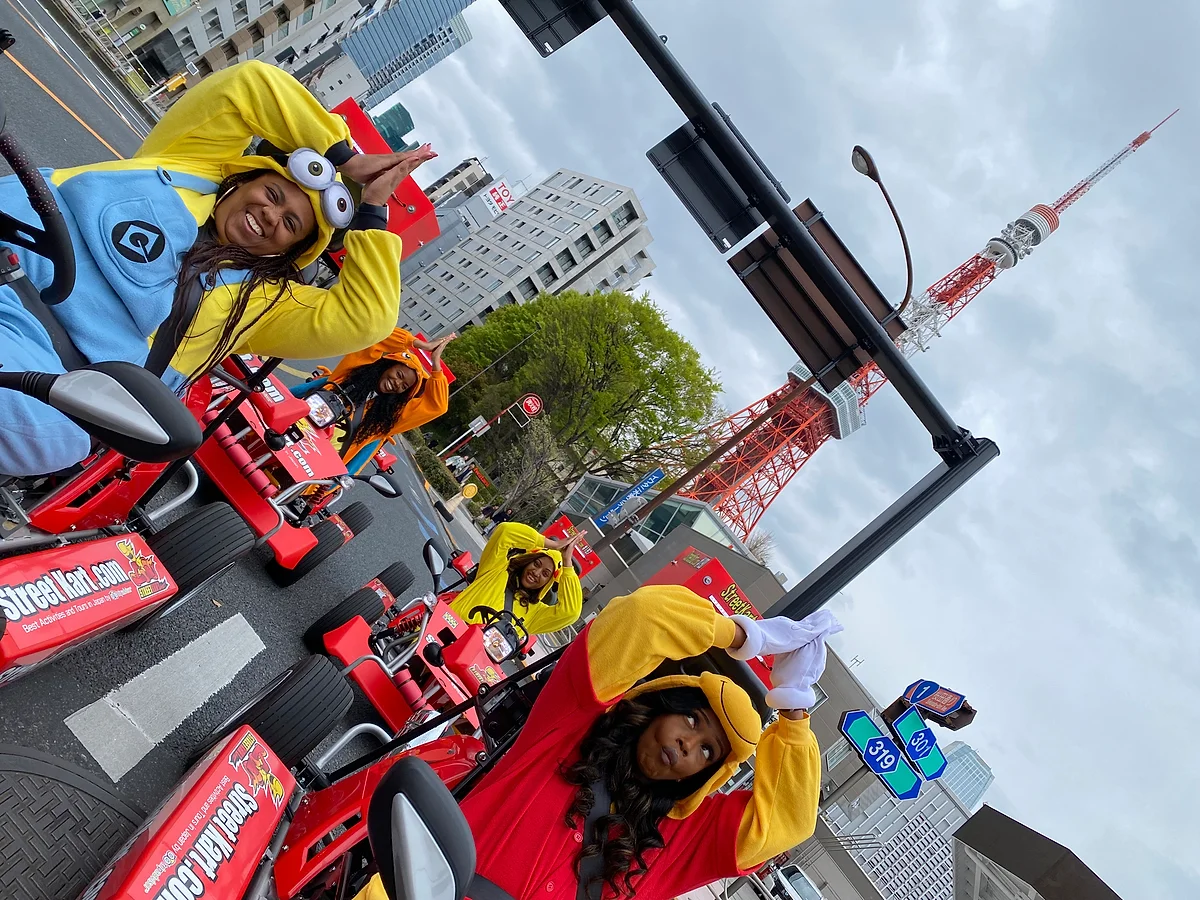
The scenery you see on the Shinagawa shop's tour is on a whole different scale from the shopping street. The business district around Shinagawa Station. The Takanawa area. The bayside office districts of Shibaura and Tamachi. And the Rainbow Bridge. Sometimes you can even spot Tokyo Tower in the distance.
The back-alley Tokyo you saw on foot. The bayside Tokyo you see from a kart. The same Shinagawa has such different faces.
On the tour, a guide leads the way. That's exactly why we recommend adding some walking time before or after. You get to experience Shinagawa from both sides.
Harajuku to Omotesando: A Flood of Color Melting into Zelkova Green
About a 15-minute walk from the Shibuya shop and Shibuya Annex is Harajuku's Takeshita Street. The density of color here is simply off the charts.
Colorful signs. Quirky clothes in the shop windows. The sweet smell of crêpes. Music flowing from the shops on both sides overlaps, so just walking along, you feel the beat in your body. If you love a party, you'll find yourself grinning!
On crowded days, though, you'll be walking while being pushed along by the flow of people. It might be a bit tiring for companions who aren't confident in their stamina. In that case, take a photo at the entrance to the street and slip straight through toward Omotesando. You don't have to walk the whole thing. Just standing at the entrance is enough to get a real feel for Takeshita Street.
Come out of Takeshita Street onto Omotesando, and the scenery changes all at once. The road widens. Rows of zelkova trees line both sides. What was a flood of color in your field of view shifts to the calm tones of greenery, stone, and architecture.
Omotesando is lined with distinctive buildings designed by architects. Omotesando Hills and Tokyu Plaza Omotesando Harajuku are also in this area. Through the eyes of a graphic designer, the whole street is a gallery. Reflections in glass, the texture of concrete, the patterns of tree shadows falling on walls. The composition changes with every step.
When I walked it, it felt much more relaxed than Takeshita Street. The zelkova-lined avenue is also known as a photo spot for Christmas illuminations. The way the colors change with the seasons is another of Omotesando's pleasures.
Go a little further, and you reach the forest of Meiji Jingu, about a 20-minute walk from the Shibuya shops. Step into this forest of roughly 700,000 square meters, and the music of Takeshita Street fades away as if it had never been there.
A colorful shopping street. A sophisticated tree-lined avenue. A deep forest. These three are all connected within walking distance. That's what makes Tokyo so interesting.
A French friend described this flow as "like a mix where the genre changes three times in one track." I thought that was a great way to put it.
The shrine grounds are vast, and you keep walking even past the great torii gate. Decide how far to go on the spot, based on how your companions are doing. Even just breathing in the forest air in front of the torii makes the contrast with Takeshita Street crystal clear.
Tours from the Shibuya shop and Shibuya Annex include scenery such as the Shibuya Scramble Crossing, the redevelopment area around Shibuya Station, and the Harajuku and Omotesando area.
The zelkova trees you looked up at while walking, now seen from a kart's low eye level. It's the same street, but the scenery flows by at a rhythm different from walking pace.
By the way, the Shibuya shop and Shibuya Annex are located at almost the same spot.
Akihabara: From a Town of Signs to a Quiet Shrine
The Akihabara Electric Town is packed with visual information. Along Chuo-dori, giant signs for electronics retailers and anime shops line up one after another. Yodobashi Camera, Akihabara UDX, Radio Kaikan. The buildings themselves shape the outline of the town.
What's interesting is how the sounds layer on top of each other. Music from each shop. Announcements at storefronts. The voices of passersby. To a DJ's ear, it's a strange mix, like multiple tracks playing at once.
Akihabara's buildings are "shopping streets stacked vertically." One building holds shops on many floors, and each time you go up a level, a different world appears. Even if a companion is worried about their feet, moving up and down inside a building lets you soak up the town's intensity without walking long distances outside.
About a 10-minute walk from the Akihabara shop is Kanda Myojin, a shrine regarded as the guardian shrine of all of Edo, with 1,300 years of history.
As if the signs and noise surrounding you just minutes earlier were never there, the grounds have a calm atmosphere. The speed of this switch is what makes walking around Akihabara so fun. A town full of the latest electronics and a shrine with a long history, only about a 10-minute walk apart.
The Kanda Festival takes place in May. During the festival period, the shrine and its surroundings get much livelier, so if you want to enjoy a quiet shrine, you may want to choose your timing.
Tours departing from the Akihabara shop include the Marunouchi building of Tokyo Station and the sights of Ginza. The red-brick station building, opened in 1914. The Wako clock tower standing at the Ginza 4-chome intersection. A Tokyo from a different era and in different colors from the Electric Town you walked appears one after another.
On foot, you saw signs and a shrine. From the kart, you see red brick and a clock tower.
Layer two Tokyos in a single day, and Akihabara's place in the city suddenly comes into focus.
How to Plan for a Group with Mixed Ages and Fitness Levels
Reading this far, some of you may be wondering, "Can everyone ride a kart?" This is the most important part, so I'll be straightforward.
Street Kart's karts are single-seaters, and there are requirements for driving them. This article won't state the participation requirements, such as age or driver's license, definitively. Please check the latest requirements on the Street Kart official website (kart.st). Members who don't meet the requirements can't ride along in a kart, either.
That's why we recommend splitting your group into "riders" and "walkers."
While the kart group is out on the tour, the walking group takes it easy at the shopping streets and shrines near the shop. When the tour ends, meet up and share the scenery you each saw.
The riders talk about the Rainbow Bridge and the red-brick station. The walkers talk about shops they found on the shopping street or the view from the top of the stone steps. It's all about the same city, yet the stories don't line up at all. And that's what makes it fun!
This way, members who aren't confident in their stamina don't have to push themselves. The walking group can rest at their own pace or wait at a café. In Kita-Shinagawa, there's Shinagawa Shrine and the shopping street. In Shibuya, head toward Omotesando. In Akihabara, there are the Electric Town buildings and Kanda Myojin. Near every shop, there are places to spend the waiting time.
A few practical notes, too. There's a convenience store within a 5-minute walk of each shop. The shops have restrooms, and Wi-Fi is available. Decide on a meeting time and place before the tour sets off. Tour duration varies by shop and plan, so please check the official website for details.
Pay attention to the season as well. Tokyo summers are hot, and even walking a shopping street can take a toll. In winter, both riders and walkers need to dress warmly. Planning frequent breaks while keeping an eye on how your companions are doing will give you peace of mind.
One more thing: the shops have no parking. Please use public transportation. The nearest stations are Keikyu's Kita-Shinagawa Station for the Shinagawa shop, and Shinsen Station on the Keio Inokashira Line for the Shibuya shops.
The Appeal of Street Kart: Seeing the Scenery as a "Flow"
Here are a few things that make the Street Kart experience appealing.
First, a guide leads the way. On every tour, a trained guide drives in front. Participants just follow behind the guide. No need to stare at a map.
Second, the unique way you see the scenery from a kart. Your eye level drops way down, so you end up looking up at the height of buildings and the size of bridges. You feel the wind and hear the sounds of the city directly. The "changing scenery" you felt on the shopping streets, you get to experience again at a completely different speed and from a completely different angle.
Third, each shop shows you a different Tokyo. Shinagawa's bayside. Shibuya's Scramble Crossing and Omotesando. Tokyo Station and Ginza from Akihabara. Which shop you choose changes the entire city you see. If you're combining it with the shopping street walks in this article, choosing a shop based on "which area you want to walk" is a good approach.
Fourth, the number of locations. Street Kart has 9 shops nationwide: 7 in Tokyo, and 1 each in Osaka and Okinawa. Of the 7 Tokyo shops, the two Akihabara shops are at almost the same spot, as are Shibuya and Shibuya Annex. In Tokyo, you can choose from bases in the Bay Area, Shinagawa, Shibuya, and Akihabara to fit your travel plans.
Fifth, its track record. As of November 2023, across all shops combined, there had been over 150,000 tours, over 1.34 million customers, and over 20,000 reviews, with an average rating of 4.9 out of 5. These facts should serve as one point of reference.
Sixth, it's easy to prepare for the language side. The official website supports 22 languages. Guidance on the day of the tour is basically in English. Guidance in Japanese or other languages depends on the staff on the day and is not guaranteed. If you're worried about language, contacting them in advance through the official website will put your mind at ease.
What to Decide as a Group Before Booking
Finally, let's talk about preparing to book.
First, decide within your group who will ride and who will walk. Riders should check the participation requirements and driver's license rules on the official website. The key is to take care of this early in your trip planning.
Next, decide which area to use as your base. If you want to walk alleys and canals, Kita-Shinagawa. If you want to enjoy shifting colors, Harajuku to Omotesando. If you want to see the contrast between a town of signs and a shrine, Akihabara. Choosing a shop based on where the walking group will have fun makes it easier for everyone in the group to come away satisfied.
Bookings are accepted via Facebook, LINE, and email (booking@streetkart.com). Weekends fill up quickly, so we recommend booking early.
Some stroll along the narrow lanes of a shopping street. Some drive down the main avenues behind a guide.
When you bring your two sets of scenery together at the end of the trip, it'll sound as if you traveled through completely different cities, even though it's all the same Tokyo. Enjoy the changing scenery of Tokyo, each at your own pace!
This article was originally written in Japanese and translated using AI. Some expressions may read unnaturally, and we appreciate your understanding. For the most accurate and up-to-date information, please refer to the official site at kart.st.
Street Kart is not affiliated with Nintendo or the Mario Kart series in any way. We do not provide costumes of Nintendo characters, and such costumes may not be worn during tours even if brought by participants.