
Riding a Street Kart Along Naha's Coast: The Prep You Can Skip, the Three Things You Can't, and What Non-Drivers Can Do
Riding a Street Kart Along Naha's Coast: The Prep You Can Skip, the Three Things You Can't, and What Non-Drivers Can Do
Through the airplane window, an emerald-green sea comes into view. It's beautiful. But you won't have much time to admire it, because the moment you land at Naha Airport, there are decisions to make. Are you renting a car? Who's driving? Which stretch of sea are you going to see?
When you're traveling with friends of different ages and energy levels, that alone can fill your head. I get it.
So in this article, I'll look at Naha's coastal roads through one question: how much of the prep can you skip? Wherever you can skip something, skip it. Only the things you can't skip get careful attention. Travel is more fun when your luggage and your to-do list are both light!
What Kind of Scenery Awaits on Naha's Coastal Roads?
Naha is the capital of Okinawa Prefecture and the gateway for visitors to Okinawa. Running through the middle of the city is Kokusai-dori, a main street about 1.6 km long. It's nicknamed the "Miracle Mile," and it's packed with souvenir shops, restaurants, and gift stores. Just walking down it gives you a lift, as if the street itself is sharing its energy with you.
Head south out of the city and the scenery changes completely. Around Naha Airport, you can watch planes take off and land up close, and you'll find yourself looking up at the sky without meaning to. Further south, out in the sea, lies Senaga Island. It's small, but it's home to Senagajima Umikaji Terrace, a cluster of white buildings with the feel of a Mediterranean resort. On clear days, the surrounding water turns a transparent emerald green. On Senaga Island, the best photo spots are your kart with the sea behind it and the white buildings of Umikaji Terrace.
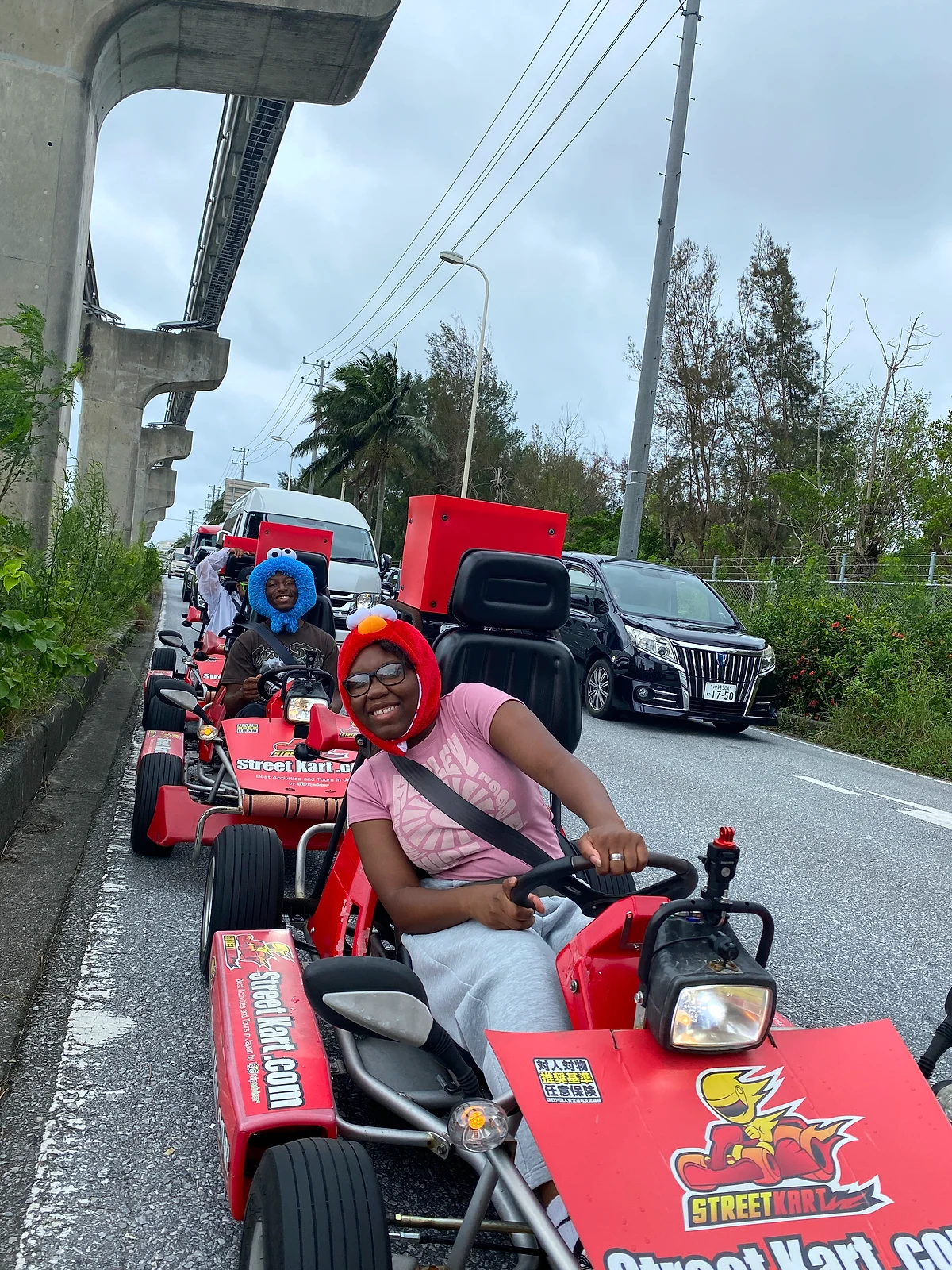
Depending on the course, Street Kart Okinawa (Naha) takes you through Senaga Island, the area around Naha Airport, central Naha, and coastal roads lined with blue sea and white sand. The mood of the scenery changes with each area.
The Okinawa courses come in two broad types. One runs from Naha Airport to Kokusai-dori. The other runs from Naha Airport via Senaga Island to Kokusai-dori. The first gives you the airport planes and the energy of the city. The second adds the coastline and greenery on top of that. If your group splits into a "we want the sea" camp and a "we want the city" camp, use this difference as a starting point for the discussion.
Some of the courses that pass through Senaga Island include a rest stop on the island where you can try Blue Seal ice cream. Some courses also have a sunset option. Watch the sun sink into the sea, or see the blue water in full daylight? Talking that over with your friends is one of the fun parts of the time before a trip.
Let me also tell you what it feels like to ride a kart. The sea breeze brushes your cheeks. The smell of salt and the sounds of the city reach you. Near the airport, planes cross the sky as they take off and land. On a course through Senaga Island, the emerald-green sea spreads out right beside you. Holding the wheel with the wind in your face, your body settles into a pleasant rhythm. This is the part I most want to get across.
On the day, you drive following the guide's lead. It's not a vehicle for detouring wherever you like. That matters, and it's exactly why you can cut so much of the prep work.
You Can Skip More Prep Than You Think
One surprisingly hard part of trip planning is working out the route. Which part of the coast to drive. Where to turn. Where to stop for photos. Someone in the group sits up late staring at a map app making plans. It's a familiar scene, and usually that person ends up the most tired of all.
With a street kart tour, you don't have to do any of this. The guide drives in front, and participants follow behind. Not having to read maps in an unfamiliar place or get lost at strange intersections takes a real weight off your mind!
That said, not having to plan the route doesn't mean someone else does the driving. You're the one behind the wheel. Follow Japan's traffic rules. Follow the guide's instructions. Keep a safe distance from the kart ahead. Obey traffic lights and signs. Those are the basics expected of you on the road. Before departure, you'll get a briefing on operating the kart and on the route, so ask any questions then.
You also don't need to arrange a rental car to see the coastline, at least for the tour portion. One more thing to keep in mind: the shop has no parking. Please get there by public transportation or similar means. Think of it as one less "what do we do about the car?" worry, which actually makes things easier.
You don't need to bring your own gear either. Helmets and goggles are provided free of charge. On rainy days, raincoats are also provided free. There's no need to buy a helmet or goggles and pack them in your suitcase.
Three Things You Still Can't Skip
Since so much can be kept light, there are a few points where I'd like you to put in the time. There are three. For everyone in the group to have a good time, don't cut corners here.
First: Confirm Who Can Drive Before You Leave
Street karts are driven on public roads, so drivers have to meet certain requirements. The required type of driver's license, age requirements, and other conditions are summarized on the official website. Requirements vary by country and license type, so check each member's situation on the Street Kart official website before you leave. Depending on the country, gathering the required documents can take time. Once your travel dates are set, look into it early for peace of mind.
One more thing: the karts are single-seaters. You can't carry a passenger. Plan how your group will spend the time on the assumption that it will split into drivers and non-drivers.
It's also worth knowing a little about the physical side. The karts have no suspension, so you'll feel bumps in the road through your body. Participation isn't recommended for people who are pregnant. If you have concerns, talk to a doctor before deciding. There are no weight or height limits, but because the engines are small, larger drivers may find their karts go slower. Use this as input when each person decides whether to ride or wait.
Second: Book Early, and Even Earlier for Weekends
Weekends tend to fill up, so booking early is recommended. Reservations are accepted via Facebook, LINE, and email. Prices vary by season and time of day, so check the latest prices on the Street Kart official website.
On group trips, someone's plans can change at the last minute. Read the cancellation and change policies before you book as well. So the person handling the reservation doesn't carry it all alone, it's a good idea to share the terms with the whole group.
On the day, you check in at the shop before departure. Confirm how many minutes early you should arrive from the information you receive when booking. If you're heading straight to the shop from Naha Airport, building in a little extra travel time will let you check in without rushing.
Third: Prepare for English-Language Guidance, Pick an Interpreter for the Safety Briefing or Raise It When Booking
If someone in your group is good at English, decide before departure who will pass along the safety-related explanations to everyone else. If no one is, mention your concerns about English when you make the reservation. Guidance on tour day is basically in English. Whether you can get guidance in Japanese or other languages depends on the staff that day and isn't guaranteed. The Street Kart official website supports 22 languages, but that's the website, separate from the guidance on the day.
Beyond the Three: What to Check the Day Before
Beyond the three essentials, here are things to check the day before: what happens if the weather turns, what to wear, and where to leave your luggage. Skies over southern islands change mood often. Check once more the night before, and you won't be scrambling on the day.
As for weather, the general rule is that tours run as scheduled in light to moderate rain. They're canceled in heavy rain or typhoons. In that case, you can choose between a shortened tour with a refund of the difference, rescheduling to another day, or canceling for a full refund. Note that in heavy rain, longer courses may be shortened. If you're planning a trip during typhoon season, leaving a spare day somewhere in your itinerary will give you some breathing room.
For clothing, footwear deserves the most attention. Closed-toe shoes, ideally sneakers, are recommended. Avoid open-toe shoes, heels, skirts, and dresses. On a beach trip it's tempting to go out in sandals, but on kart day, switch shoes. In summer, sunscreen and something to drink are also handy.
You might spend the morning at the beach and ride the kart in the afternoon. If so, build time into your schedule to shower and change. Don't head over in a wet swimsuit and flip-flops; change into clothes that are easy to move in and sneakers before going to the shop.
Luggage needs some care, though. The shop has lockers for small items, but they're said to be unsuitable for large bags like suitcases. What you can carry on the kart is about a small bag. If you're planning to go straight from the airport to the shop, check in advance what to do with your large luggage for peace of mind.
How Can Non-Driving Friends Spend Their Time?
When you travel with people of different ages and energy levels, getting everyone to do the same thing is hard. Some won't want to drive. Others won't be able to because they don't meet the requirements.
So let's shift the thinking a bit. Not everyone has to ride a kart. Everyone can spend time in the same city of Naha at their own pace.
Around the Okinawa shop, there are several places to spend the time during the tour. These aren't on the tour course; they're spots near the shop. For members who don't mind walking, Kokusai-dori and Makishi Public Market are about a 10-minute walk from the shop. Makishi Public Market is known as "Okinawa's kitchen." It's full of Okinawan ingredients, and on the second floor they'll cook ingredients you bring up. Just looking at the food on display and wondering "how do you eat this?" makes the time fly.
For members with a sweet tooth, there's also a Blue Seal shop on Kokusai-dori. If the driving team picked a course that stops at Senaga Island, you'll end up eating the same ice cream, one group on the island and the other in the city. Asking each other "which flavor did you get?" afterward is a small bonus.
Another good idea is to put someone in charge of souvenir hunting. Near the shop, besides the souvenir stores on Kokusai-dori, there's Okinawaya, and Okashigoten, known for its purple sweet potato tarts. For food, names that come up include Tondo for Okinawa soba and Urizun for Okinawan cuisine. If the non-drivers scout out a dinner spot before the driving team returns, things will go much more smoothly once you regroup.
Pottery lovers can head to Yachimun-dori (Tsuboya), about a 15-minute walk away. It's a calm area lined with pottery shops and cafés. The colors and shapes of the rustic pieces become more interesting the longer you look. For members who want to see the sea, Naminoue Beach is about a 20-minute walk away. It's a beach within Naha city, with Naminoue Shrine right next to it.
Some people may not want to walk much. In that case, decide on a place near the shop to rest before departure. Sharing the meeting spot and a rough time to regroup with everyone is enough. When the driving team gets back, everyone heads to Kokusai-dori together. Some will want to talk about the karts; others will want to talk about the food they found at the market. With two sets of stories, the dinner table gets lively!
Here's how I see it: not everyone has to do the same thing. All that matters is ending up at the same table. Of course, doing everything together has its own appeal. In Naha, you can have the best of both.
Once You've Decided on Naha, Here's What to Do First
There are three things. Confirm the requirements for the members who will drive. If you're aiming for a weekend, book early. To prepare for English-language guidance, decide who will relay the safety briefing, or raise it when you book. Once those three are done, along with checking the weather, clothing (closed-toe shoes), and where to leave large luggage the day before, all that's left is to enjoy Naha's sea and wind. For the non-drivers, the market, the pottery shops, and the sea at Naminoue are waiting.
Start by checking the Okinawa shop information and participation requirements on the Street Kart official website, and share them with your friends. The emerald-green coastal road is waiting. Let's go!
This article was originally written in Japanese and translated using AI. Some expressions may read unnaturally, and we appreciate your understanding. For the most accurate and up-to-date information, please refer to the official site at kart.st.
Street Kart is not affiliated with Nintendo or the Mario Kart series in any way. We do not provide costumes of Nintendo characters, and such costumes may not be worn during tours even if brought by participants.